If you just signed a copier lease, you probably have a few questions running in the background: Will the equipment show up on time? What happens if something breaks? Are there fees you didn't see coming? Will your team actually know how to use this thing?
Those are fair questions, and this guide answers them. Here's what to expect in the first year of a copier lease from delivery and training through your first service call and your first real look at your invoice, so you can set the right expectations for your team and nothing catches you off guard.
What to expect during the first month of a copier lease
The first few weeks of a copier lease are the most active. Here is what typically happens.
Copier delivery and setup
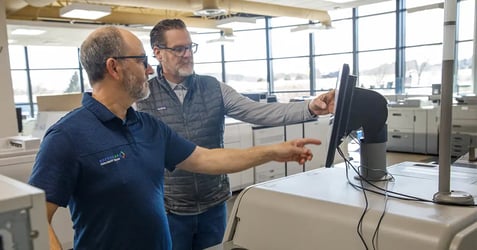
Your equipment provider schedules delivery and coordinates placement based on the initial site survey. Your workflow, settings, and security requirements are preconfigured in advance. A technician then sets up the device and connects it to your network.
If you are replacing an old printer or copier, your provider should help you plan for the transition. This includes timing the swap to minimize downtime, migrating any settings or address books that carry over, and removing hard drives.
Employee training for your new copier
Most providers offer hands-on training during installation. This is the right time to loop in the people who will use the device most. The training needs may vary depending on role.
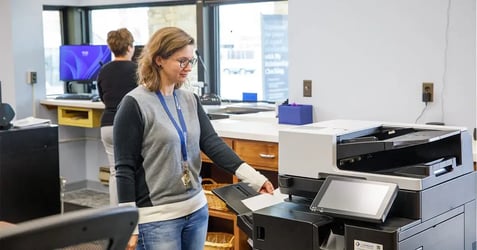
Training typically covers basic print and copy functions, scanning workflows, loading paper and replacing toner, and how to place a service call if something goes wrong.
If your team has questions after installation, a good local provider makes it easy to call for support and should offer additional training as staff and equipment needs change. You should not have to navigate a national call center to ask a simple question.
Network and IT coordination
If your business has an IT team or a managed IT provider, loop them in early. Your copier technician will need access to your network to finalize the setup, and having an IT contact available speeds up the process. Most modern multifunction printer leases also support mobile printing and cloud-based document workflows, so this is a good time to confirm those features are working as expected.
How copier lease billing and supplies work in months two through six
Once your team is comfortable with the equipment, the lease moves into a quieter phase. Most businesses find that day-to-day print operations run in the background without much thought — which is exactly the point.
Automated toner and supply management
One of the most common benefits of a managed print agreement is automated supply delivery. With the right service plan, toner is shipped to you before you run out which is typically triggered when the device reports it is running low. This removes the guesswork of tracking supply levels manually.
If your lease includes a managed print services (MPS) component, your provider may also track device usage and flag any devices that are printing significantly more or less than expected. That kind of visibility can surface cost savings or workflow issues you might not have noticed otherwise.
Understanding copier lease billing and per-page charges
Copier leases typically bill in one of two ways: a flat monthly rate that covers the device, or a base rate plus a per-page charge (cost-per-copy or CPC). Many agreements combine both.
Review your first few invoices to confirm you understand what is being billed and why. Common line items include:
- Monthly lease payment for the device
- Color and black-and-white per-page charges, billed separately
- Service and maintenance fees, if not bundled into your agreement
- Overage charges if you exceed a contracted volume tier
If anything on your invoice is unclear, ask. A straightforward explanation is something you should be able to get from your account contact.
Preparing for your first copier service call
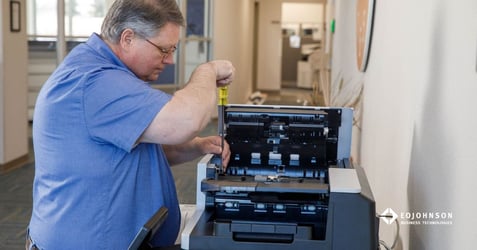
At some point in the first year, you may need a service technician. A paper jam that will not clear, an error code that keeps returning, or print quality issues. These things happen with any equipment, and they are not a sign that something is fundamentally wrong.
What matters is how quickly your provider responds. A local service team with technicians placed throughout Wisconsin, Iowa, Minnesota, and the UP will be able to reach you faster than a national provider dispatching from a distant territory. When you evaluate your agreement, response time commitments are worth understanding up front.
How to evaluate your copier lease during months seven through twelve
By the second half of your lease's first year, you have real data to work with. You know how much you are printing, which features your team uses, and whether your current setup is meeting your needs.
Reviewing your actual print volume
Compare your actual monthly page volume to what you estimated when you signed the lease. If you are consistently under your contracted volume, you may be paying for capacity you do not need. If you are consistently over, you may be accumulating overage charges that add up over time.
This is a conversation worth having with your account manager before the end of year one and shouldn’t wait until renewal time. A reputable managed print provider will be reaching out to check in and should offer a business review.
Determining whether your copier meets business needs
Has the equipment held up? Is it fast enough for busy periods? Does your team use the scanning and document management features, or are those going unused?
These observations inform your next lease decision. If your needs have shifted — a new office location, a change in team size, or a shift toward digital document workflows — knowing that before you renew gives you more options.
Building a relationship with your copier provider
One of the differences between a transactional vendor and a long-term technology partner is how they engage with you between service calls. A good managed print provider checks in periodically, monitors device performance, and brings ideas to you rather than waiting for a problem to surface.
If you have not heard from your account contact by month six, that is worth noting. Proactive service and support are part of what you are paying for.
Frequently asked questions about copier leasing
Talk to an EO Johnson expert about your copier lease
If you have questions about your current copier lease or you want to make sure your next one is set up for success, our team is here to help. EO Johnson provides managed print services across the Midwest. We’re proudly local, family- and woman-owned, and serve Wisconsin, Iowa, Minnesota, and the Upper Peninsula of Michigan. We are happy to walk through your situation and help you understand your options.