Updated January 5, 2026
If your business is still relying on paper files, shared network drives, or outdated processes, you may be losing revenue without realizing it. Hidden inefficiencies like slow retrieval, manual data entry, compliance risks, and costly storage space chip away at productivity every day. For smaller businesses with tight staffing and tighter budgets, improving document management ROI is one of the fastest, most cost-effective ways to strengthen operational performance.
Today’s document management tools make it possible to automate workflows, centralize information, and reduce overhead without large capital investments. Even small, incremental changes can unlock measurable gains in efficiency and profitability.
Five ways secure document management drives ROI
1. Cutting labor costs through faster retrieval and workflow automation
Employees spend far more time hunting for documents than most businesses realize. Scattered information systems remain a top barrier to effective work. Modern document management systems leverage AI indexing for automating classification of important data. Documents can also be fully text searchable so that files can be instantly discovered--whether they’re scanned from paper, uploaded by MS Teams, or generated automatically through integrated applications.
For SMBs that can’t afford time-wasting processes, workflow automation offers a major lift. Automated routing, version control, e-signatures, and role-based access reduce repetitive manual tasks so lean teams can focus on revenue-driving activities, not clerical work. This directly improves document management ROI by lowering labor costs and accelerating cycle times for sales, service, and operational processes.
2. Reducing physical storage costs with cloud document storage
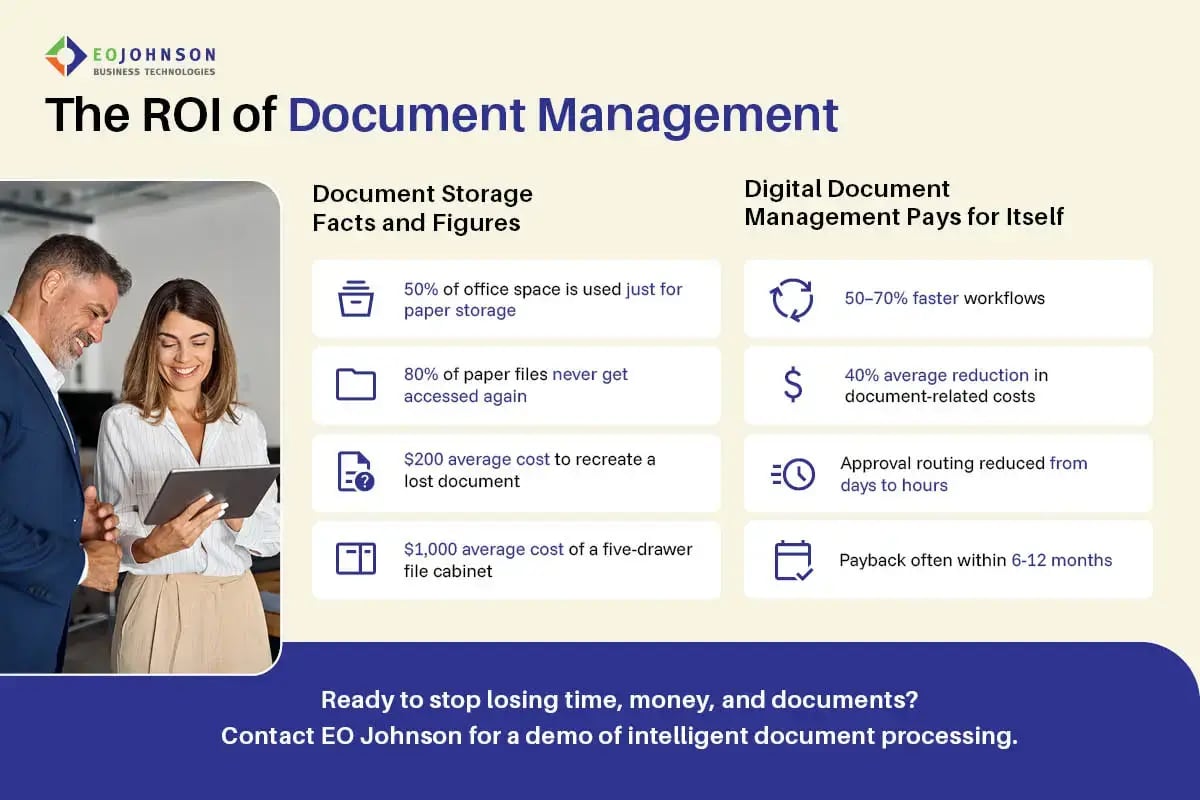
Office space is expensive and using it to store paper files drains operational budgets. Cloud document storage eliminates the need for filing cabinets, onsite storage rooms, or costly offsite retention services. With modern retention and compliance tools, organizations can securely archive digital documents at a fraction of the cost of maintaining physical records.
Cloud platforms also support hybrid and remote work, reducing friction when employees are not in the same location. The shift to cloud storage is a key element of document management, and many businesses see immediate savings while laying the groundwork for long-term digital transformation ROI.
3. Lowering audit and compliance preparation costs
Audits, whether financial, regulatory, or internal, can stretch smaller teams to be even thinner. Preparing documentation manually is time-consuming and often error prone. By implementing document scanning and indexing tools that automatically convert paper files into searchable PDFs, teams can pull required documents in seconds instead of hours.
A modern document management and archiving system tracks version histories, access logs, and approvals, making audit trails easier to produce and less costly to prepare. The combination of automation and improved accuracy helps businesses minimize audit fees, reduce employee workload, and ensure compliance without hiring additional staff.
4. Improving visibility into business performance
Sound decision-making depends on accurate, accessible information, but many SMBs lack a centralized document repository. With fewer resources for data management, financial statements, contracts, and operational records often live in separate systems or physical folders.
By consolidating documents in a secure, searchable platform, businesses gain clearer visibility into spending patterns, vendor agreements, staffing needs, and performance indicators. This unified view supports stronger planning and more confident budgeting - two factors that significantly influence document management ROI.
AI-powered analytics within modern systems can also bring to light insights that were previously buried, helping leaders spot risks, eliminate redundant processes, and identify new opportunities for growth.
5. Reducing risk and preventing costly damage or loss
Physical documents remain vulnerable to fires, floods, theft, and environmental deterioration. Replacing damaged records (if replacement is even possible) can be extraordinarily expensive and disruptive. Secure document management solutions protect records through encryption, redundant cloud backups, and granular access controls. Digital protections are significantly more reliable than traditional storage rooms, especially for small businesses.
Going digital also reduces paper-related expenses, including printing, copying, shredding, and offsite storage. Over time, these savings compound, strengthening the overall business case for modernization.
How AI and automation are transforming document management
The leap forward in AI indexing for documents is one of the most significant advancements since the early days of digital storage. AI can now:
- Automatically recognize and categorize content
- Extract key data points from invoices, forms, and contracts
- Enable natural-language search (e.g., “Show me all vendor contracts expiring this quarter”)
- Identify anomalies that may require review
For smaller organizations, this means high-value capabilities once accessible only to large enterprises are now affordable, easy to deploy, and available with minimal IT overhead.
Whether it’s improving invoice processing, creating a digital mailroom, or any other internal paper process, the result is a dramatic improvement in digital transformation ROI powered by faster workflows, fewer errors, and better insights.
Where is the drag on your document management ROI?
Every business, regardless of size or industry, can benefit from updating its document management approach. The technology has never been more intuitive, secure, or budget-friendly. Whether you start by scanning legacy paper files, implementing workflow automation, or moving to cloud-based storage, each step reduces cost and strengthens operational resilience.
Businesses that modernize are seeing measurable improvements in productivity, customer experience, and long-term profitability. If you’re ready to eliminate the hidden “paper drag” holding back your organization, now is the ideal moment to evaluate your current system and take the next step in document management modernization.
Don’t wait to reap the benefits of smarter document management. Contact our team to schedule a personalized assessment or learn more about solutions that fit your business needs.