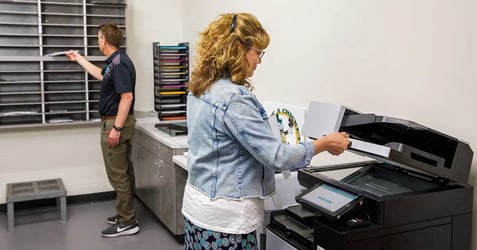
When a printer goes down in the middle of a busy workday, the instinct is to call your most tech-savvy employee over to fix it. And sometimes that works. But across manufacturing floors, healthcare offices, finance firms, and school districts throughout the Midwest, that approach quietly drains time, money, and patience. For mid-sized businesses managing multiple locations or devices, outsourcing printer maintenance is a smarter way to operate.
The hidden costs of in-house printer maintenance
Most operations managers don't have a line item called "printer chaos," but the costs are real. They just aren’t as obvious because they are scattered across the day.
Billable staff time spent troubleshooting
Every time an employee stops what they're doing to clear a paper jam, diagnose an error code, or spend 40 minutes on hold with a manufacturer's support line, that's billable time evaporating. For a $35/hour operations coordinator, even two hours a week spent wrangling printer issues adds up to roughly $3,600 a year. That's before considering the opportunity cost of the work they didn't complete.
In organizations with multiple devices or locations, the problem multiplies. IT team members, who are hard to staff and retain, often find printer troubleshooting landing in their queue despite having far higher-priority responsibilities.
Emergency printer repair and variable parts costs
Unplanned repairs are expensive in two ways - the invoice itself and the scramble to arrange it. Without a managed service agreement, businesses typically pay per-incident rates that can run several hundred dollars per visit, plus the cost of parts. Fuser units, feed rollers, and drum assemblies aren't cheap, and sourcing them quickly often means paying a premium.
There's also the unpredictability. Budget-conscious operations managers know that surprise repair bills are harder to absorb than planned, predictable costs. When equipment fails without warning, you have to deal with an unplanned expense on top of the downtime.
What does outsourced printer maintenance include?
A managed print service agreement isn't simply "someone comes when things break." A comprehensive contract typically covers several layers of support.
Routine preventive printer maintenance
Rather than waiting for failure, factory-trained technicians follow each device’s manufacturer-recommended preventive maintenance schedule, servicing equipment at the right intervals for the make and model. That may include cleaning components, replacing wear items before they cause problems, calibrating performance, and updating firmware to support security enhancements and, in some cases, new features. This proactive approach helps maximize uptime, extend equipment life, and reduce the likelihood of emergency service calls.
Fast on-site printer repair and remote support
When something does go wrong, response time matters. "If we call for service on a printer, someone is here same day. We can't afford to have downtime. That's huge for us," says Alica Streich, Controller at Synergy Cooperative. Local service providers can dispatch technicians quickly, often same or next day, rather than routing you through national call centers. Proactive print service and remote diagnostics also allow many issues to be identified (and sometimes resolved) before a technician ever sets foot in your building.
Automated toner and supply fulfillment
Many managed agreements include automated toner monitoring and replenishment, so supplies arrive before you run out, not after someone puts an empty cartridge on the printer as a reminder. "EO Johnson helps us avoid disruption and downtime every day. They're monitoring toner, parts, and supplies before a problem even occurs," says Noah Wallace III, IT Director at Silver Spring Foods. That kind of proactive visibility eliminates a recurring procurement headache and ensures devices are always ready to perform.
The business case for professional printer maintenance: Reducing downtime
A printer that's down for two hours in a busy office is more than an inconvenience. It's a productivity event. Documents don't get printed. Workflows stall. Employees improvise (or go home frustrated). In healthcare and finance settings, where printed documents are tied to compliance workflows, the stakes are even higher.
Consider a 50-person office where a shared device goes offline for half a day. If even 20 employees are moderately impacted, losing 30 minutes each of productive time, that's 10 hours of lost labor. At an average cost of $40/hour, that's a $400 incident. And that’s just one outage, on one device, on one day.
Organizations that rely on a local provider with strong service infrastructure can significantly reduce both the frequency and the duration of those outages.
Predictable printer maintenance costs vs. surprise bills
One of the clearest arguments for outsourcing printer maintenance is financial visibility. A managed service agreement converts your print environment from a variable, unpredictable cost center into a fixed monthly line item. You know what you're paying. You can budget for it. And you're not holding your breath every time someone loads paper. For businesses managing tight IT budgets, predictability is part of sound fiscal planning.
The difference becomes clear when you compare the two approaches side by side.
Key questions to ask before signing a printer maintenance agreement
Not all managed print agreements are created equal. Before committing, ask prospective providers these questions:
Working with a local, relationship-driven provider means gaining a partner who understands your business climate, knows your equipment, and shows up when it matters. "Fantastic prompt and friendly service. The service tech was extremely informative with letting us know what the problem was," says Eric Arneson of Flex Craft. That kind of transparency is what separates a vendor from a true technology partner.
Choosing the right approach to printer maintenance
Outsourcing printer maintenance won't make headlines, but it will make your workdays smoother. For operations managers and IT leaders tasked with keeping the business running efficiently, it's one of the most practical technology decisions you can make.
Ready to reduce downtime and simplify print management? Let’s talk about a managed print services plan built for your business.