Updated February 16, 2026
For years, the goal of document scanning was simply to eliminate paper. Businesses wanted filing cabinets gone, storage rooms cleared, and documents converted into digital files. In2026, that goal has fundamentally shifted. Today, scanning automation isn’t only about digitization but is also about transforming physical documents into structured, searchable, and AI-ready data that fuels smarter, faster business decisions.
Modern organizations are rethinking how information enters their systems. Instead of static PDFs that sit unused, scanning automation now plays a critical role in digital transformation by feeding downstream systems with accurate, contextual data. At the center of this evolution is intelligent document processing (IDP), advanced optical character recognition (OCR) automation, and AI-driven metadata tagging which are capabilities that Scanshare was built to support.
Why scanning automation looks different today
Traditional scanning workflows removed paper but left many of the surrounding tasks untouched. Documents were scanned, saved, and stored, but employees were still responsible for scanning documents to themselves, naming files, entering data into business systems, and figuring out where information belonged. Over time, this created large volumes of digital content that were difficult to search, govern, and trust.
For many organizations, the real challenge isn’t paper, but it’s what happens after documents are scanned. While information may be digitized, the work surrounding it often remains manual, fragmented, and slow. This hidden layer of inefficiency, known as digital friction, quietly impacts productivity, compliance, and cost across the organization.
Here’s where digital friction typically hides once paper is gone.
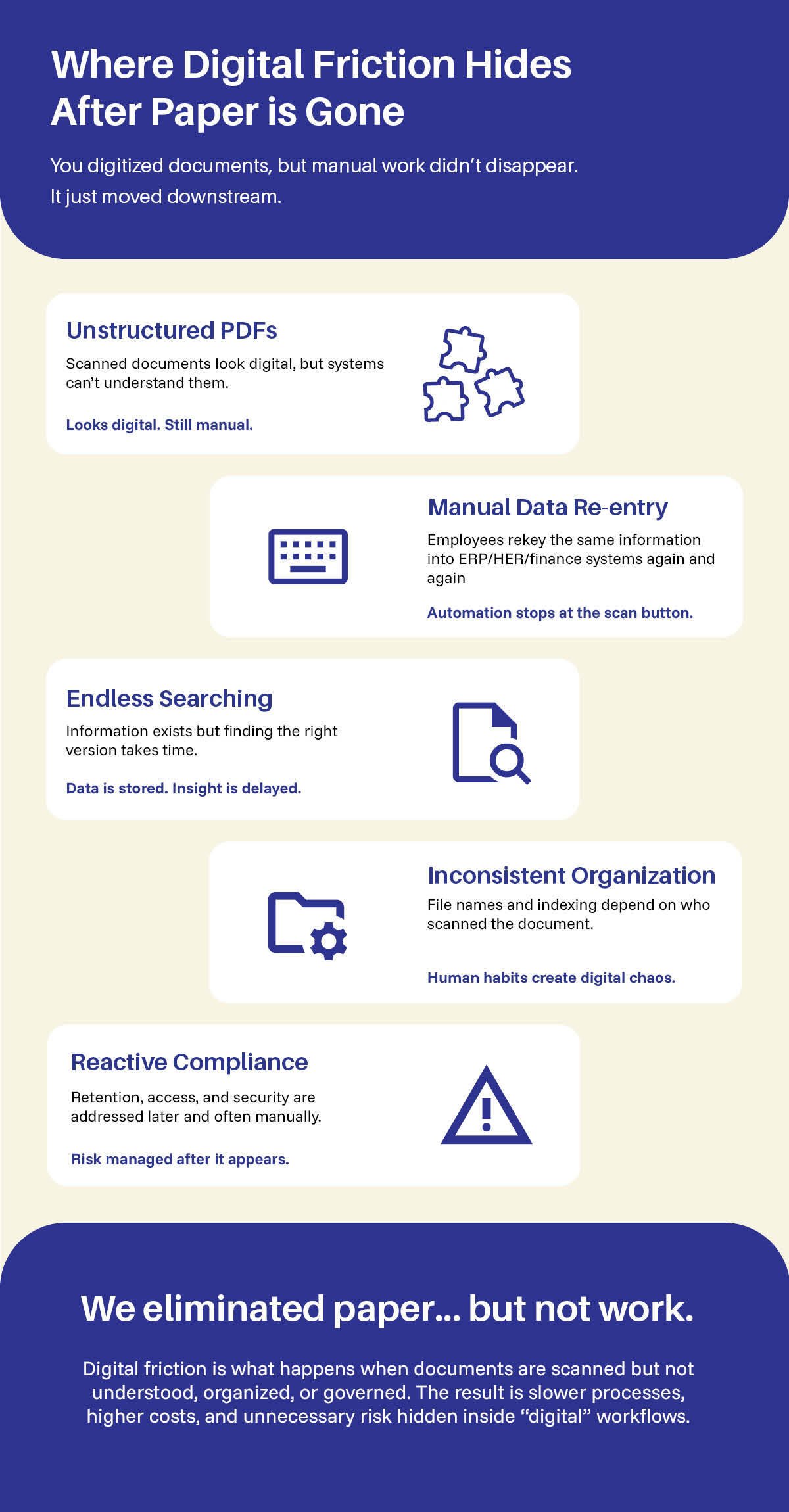
Modern scanning automation replaces this digital friction with intelligence. Using OCR automation combined with AI and rules-based logic, documents are captured once and automatically understood, classified, and routed without relying on human intervention. The result is faster processing, higher data accuracy, standardization, and information that’s immediately usable across the business.
OCR and the role of intelligent document processing
OCR used to be about recognizing characters on a page. Today, OCR automation has evolved into Intelligent Document Processing (IDP), or technology that understands the structure, intent, and context of a document.
With IDP, scanning automation can:
- Identify document types automatically (invoices, medical records, contracts, HR forms)
- Extract complex data fields accurately, even when layouts vary
- Validate data against business rules and downstream systems
- Route documents based on content, not just filenames or folders
This contextual understanding is especially valuable in industries managing high volumes of unstructured information, such as healthcare, legal, finance, and manufacturing. Instead of employees manually reviewing documents, IDP ensures data is captured correctly the first time and delivered where it’s needed.
Scanshare is scanning automation built for AI-ready workflows
Scanshare is a scanning automation solution designed to meet the demands of modern document workflows. Rather than simply moving files from paper to digital, Scanshare focuses on turning documents into usable, governed data.
By integrating with multifunction devices, email, mobile capture, and existing document management systems, Scanshare acts as the front door for information entering the organization and ensures every document is captured, processed, and stored with purpose.
Scanshare’s three-step scanning automation process
Scanshare’s intelligent three-step process illustrates how modern scanning automation transforms documents into actionable data for today’s organizations.
1. Capture
Scanshare enables fast, consistent document capture from office multifunction devices, email inboxes, and mobile devices. Users are guided through simple prompts that ensure documents are sent to the correct workflow every time and reducing errors at the point of entry.
2. Process
This is where modern scanning automation delivers the most value. Using OCR automation, IDP, barcode recognition, and AI-driven learning, Scanshare can automatically:
- Classify documents
- Extract key data fields
- Apply business rules
- Trigger workflows or alerts for exceptions
Over time, the system learns from prior actions, reducing the need for manual configuration and improving accuracy as document volumes grow.
3. Store
Documents and extracted data are securely stored in the appropriate document management systems, ERP platforms, or cloud repositories. Role-based access and Active Directory integration ensure sensitive information is protected while remaining accessible to authorized users.
Eliminate the digital junk drawer with AI metadata tagging
One of the biggest challenges organizations face today isn’t paper - it’s poorly organized digital content. Without proper indexing, scanned documents quickly become a "digital junk drawer."
Scanshare addresses this with AI metadata tagging, automatically identifying key attributes such as document type, customer name, invoice number, or date. This metadata makes documents instantly searchable and ensures information is organized consistently without relying on employees to manually tag or name files.
The result is faster retrieval, better reporting, and greater trust in enterprise data.
Build in document retention compliance
Scanning automation must also support governance. Modern solutions now include built-in document retention compliance, helping organizations manage the full lifecycle of information.
Scanshare supports automated retention policies that alignwith evolving legal, regulatory, and security requirements. Documents can beretained, archived, or securely disposed of based on predefined rules to reducerisk while eliminating manual oversight.
This proactive approach to compliance is especially important as regulations continue to change and data volumes grow.
Reduce digital friction across the organization
Manual data entry, rekeying information, and searching for documents all create digital friction that slows teams down. By automating capture, classification, and routing, scanning automation removes these bottlenecks and shortens these processes from hours to seconds.
Organizations that reduce digital friction benefit from:
- Long-term cost savings through reduced manual labor
- Improved employee experience and job satisfaction
- Faster decision-making with more reliable data
- Greater agility as business needs evolve
Rather than reacting to information after it’s processed, teams can act on data as soon as it enters the system.
Moving forward with scanning automation
Scanning automation has evolved into a strategic foundation for digital transformation. By combining OCR automation, intelligent document processing, AI metadata tagging, and document retention compliance, solutions like Scanshare help organizations move beyond digitization and toward intelligent document management and data-driven operations.
The digital transformation team at EO Johnson helps organizations design scanning automation strategies that reduce friction, improve compliance, and unlock the full value of their information. If you’re ready to turn paper into AI-ready data, we’re ready to help.