
Regulatory compliance is a daily reality for Midwest manufacturers. ISO, OSHA, and EPA standards require consistent documentation, traceability, and proof of process control. Yet, many small and mid-sized manufacturers still rely on paper files and manual recordkeeping systems that slow down audits and increase compliance risk.
Secure document scanning for manufacturers eliminates those pain points. By digitizing compliance records into secure, searchable formats, manufacturers gain better control over documentation, data integrity, and audit readiness.
Why compliance demands digitization
Manufacturing compliance depends on accurate records for things like safety training logs, calibration certificates, quality assurance reports, and environmental documentation. When these are paper based, they’re hard to manage and easy to lose.
Digital records, by contrast, are indexed, backed up, and instantly retrievable. This reduces administrative time and strengthens adherence to ISO and OSHA document management requirements for version control, record retention, and access verification.
In short, document digitization for manufacturing turns compliance from a reactive burden into a proactive system.
What document digitization for manufacturing really means
Secure scanning processes do more than just convert paper documents into PDFs. They are part of a controlled document management system that is designed to meet both compliance and data security standards.
A compliant digital document workflow should include:
- Encryption of scanned files in transit and at rest
- Access controls based on user roles
- Audit trails that track viewing and edits
- Retention rules aligned with regulatory timelines
- Version control to ensure only approved procedures are used on the production floor
When implemented properly, secure document scanning ensures records are protected, traceable, and ready for any audit.
Documents that benefit most from digitization
Manufacturers maintain a wide range of compliance documentation. Common categories that benefit from secure scanning include:
- Quality assurance and inspection reports
- Production and batch records
- Material certifications and supplier documents
- OSHA safety records and training logs
- MSDS and chemical handling sheets
- Equipment calibration and maintenance logs
- Environmental or waste management reports
Assigning index fields such as job number, date, part ID, or certification type ensures retrieval is both fast and accurate, which is ideal for achieving digital audit readiness.
Key benefits of secure document scanning for compliance
Secure document scanning streamlines compliance, boosts operational efficiency, and safeguards data to ease regulatory readiness and create smarter manufacturing processes. Let’s take a closer look.
Protecting sensitive data
Manufacturing records often contain proprietary product data, intellectual property, employee information, or supplier details. That’s why secure data storage in manufacturing is as important as the scanning process itself.
Simplifying audits and inspections
Digitized records make audits faster and less stressful. Instead of digging through file cabinets or off-site storage, staff can locate required documents instantly using search tools. With compliant document scanning, your facility is always audit-ready.
Integrating with ERP and QMS Systems
Digitized compliance records gain even more value when integrated with your existing Quality Management Systems (QMS) or Enterprise Resource Planning (ERP) systems. Scanned documents can be linked directly to production orders, supplier files, or quality events, providing a full traceability chain from raw material to finished product.
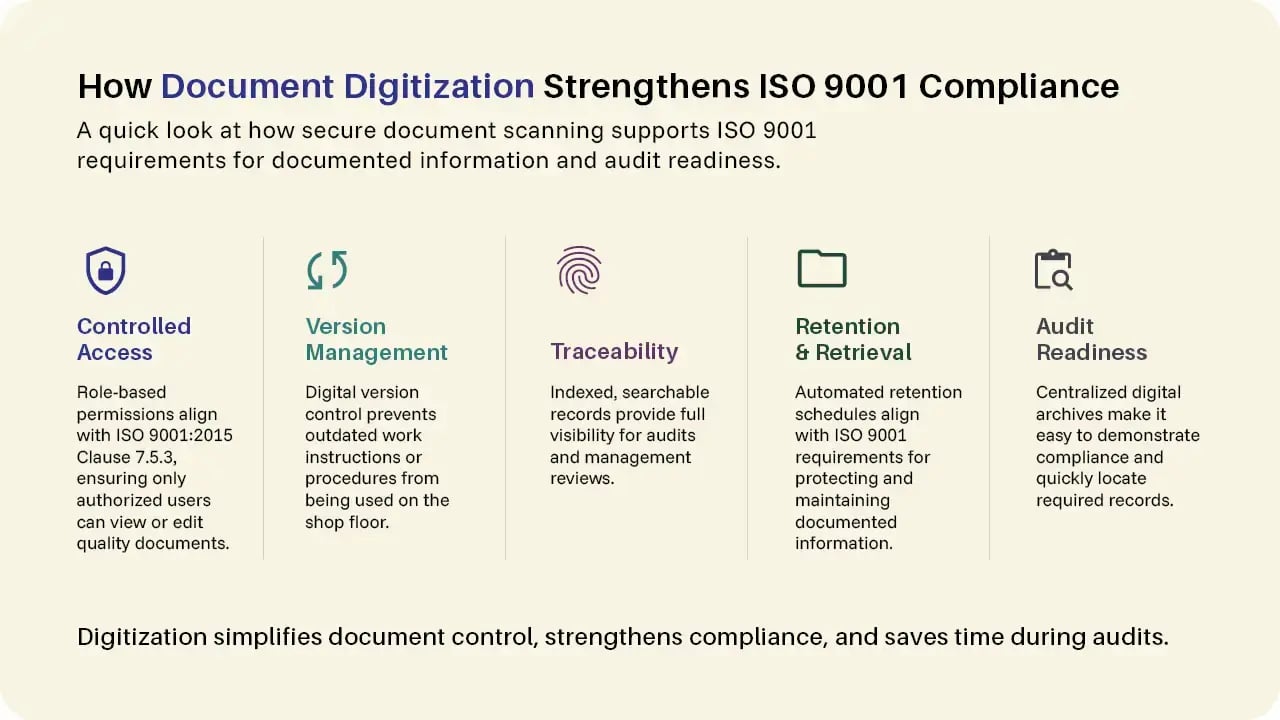
Here’s a quick example of how going digital with your documents helps meet ISO 9001 standards.
Best practices for a secure scanning project
When planning a compliance scanning initiative, you may decide to outsource the project to a document scanning service with the production capacity to complete the work efficiently. To ensure consistent and secure results, consider the following steps as you collaborate with your scanning vendor:
- Establish a chain of custody. Track every document from pickup to digital storage.
- Use role-based access. Limit file access by job responsibility.
- Verify scan quality. Ensure documents are legible, complete, and properly indexed.
- Automate retention schedules. Align record retention and destruction timelines with ISO and OSHA document management standards.
- Choose a compliant vendor. Confirm your provider follows security-based protocols.
These practices protect your data and demonstrate due diligence during audits.
Building a compliance-ready manufacturing operation
For smaller manufacturers, compliance scanning delivers immediate ROI with less paper storage, faster audits, and fewer compliance issues.
More importantly, it establishes a foundation for smart production recordkeeping, where information flows securely and efficiently across departments.
As regulatory demands increase, secure document scanning for manufacturers is essential to maintaining certifications, protecting data, and staying competitive.
Contact our digital transformation experts to develop your compliance-ready scanning strategy today.