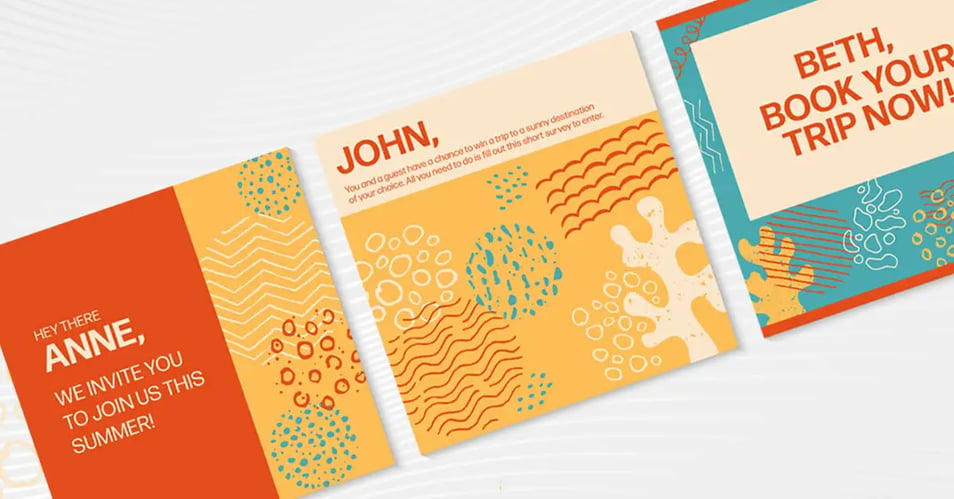
Personalization is now the baseline for how people expect brands to communicate. Streaming services recommend what to watch next, online ads follow what we browse, and emails arrive with our names and order history already filled in. In Salesforce's State of the Connected Customer research, 73% of customers said they expect companies to understand their unique needs and expectations.
Print can meet that expectation too. Variable data printing (VDP) lets every mailer in a run speak to the person receiving it, and direct mail starts with an advantage. Response rate research from the Association of National Advertisers (ANA) has long shown direct mail drawing far higher response than email.
"While digital marketing often grabs the spotlight, personalized print materials have a unique ability to create lasting impressions," said Tracey Armstrong, Vice President of Marketing at EO Johnson Business Technologies.
This guide covers how variable data printing works, where it fits in direct mail and transactional programs, and which production print solutions we recommend for personalized mailers.
What is variable data printing?
Variable data printing is digital printing that changes text, images, or other design elements from one piece to the next within a single print run. Traditional printing produces identical copies. VDP produces a unique piece for every recipient without stopping the press.
Picture a postcard from your favorite clothing store. Instead of "Dear Customer," it says, "Hi Emily!" and shows the jacket you looked at online last week. That's variable data printing for mailers in action with each piece feeling personal because it is.
How does variable data printing work?
VDP connects a design template to a customer database. A typical workflow has four steps:
- Build the template. Designers create the base layout with placeholders for names, images, offers or codes.
- Connect the data. The template links to a list from your CRM or mailing database, such as names, addresses, purchase history, or preferences.
- Print the run. VDP software merges each record into the template, and the press produces every unique piece at full speed.
- Finish and mail. Pieces move to folding, inserting and addressing, then get sorted for postal delivery.
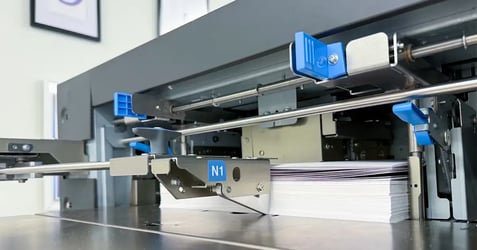
The press gets most of the attention, but steps 2 and 4 are where in-house VDP programs most often slow down. Clean data and a finishing line that keeps pace matter as much as print speed.
Direct mail printing vs. transactional printing
Variable data printing powers two kinds of mail:
- Marketing mail - such as postcards, coupons, invitations, and fundraising appeals where personalization drives response.
- Transactional printing - such as statements, invoices, benefits notices, and policy documents where every piece carries account-specific information and accuracy can't slip.
Many in-plant printers run both. Transactional work adds requirements around data security, piece-level tracking and on-time delivery, which shapes the equipment and workflow you need.
Why variable data printing works for direct mail
- Higher engagement. People pay attention to what feels relevant. A name, a nearby location or a product they've already shown interest in gives the piece a reason to be read.
- Customization without extra runs. Because VDP is digital, a 10,000-piece campaign with 10,000 versions prints in one pass.
- Better return on spend. Matching each offer to where a customer is on the buying journey puts budget behind messages more likely to convert.
- Speed for time-sensitive campaigns. A last-minute promotion or seasonal greeting moves from data file to mailbox faster when the work runs in-house.
“Marketing teams often assume personalized mail means a bigger budget. With clean data and the right equipment, that isn't necessarily the case because you stop paying to print and mail pieces that are generic and don’t really speak to anyone.”
– Tracey Armstrong, Vice President of Marketing, EO Johnson
Best production print solutions for variable data mailers
The right printing press depends on your monthly volume, the stocks your mailers use, and how much your campaigns rely on visual impact. These four are our picks from the lines we carry.
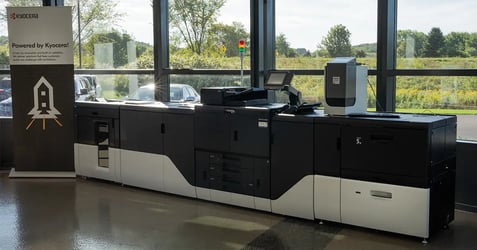
1. Kyocera TASKalfa Pro 15000c: high-volume personalized mail
Our pick for: in-plants running large, full-color personalized campaigns or transactional mailings.
At about 146 ppm (letter) and positioned for roughly 150,000 to 2 million pages a month, the 15000c keeps big campaigns in-house. Kyocera states up to 70% lower cost per page than comparable toner systems, and that's where full-color, fully personalized mail pays off. Every piece can be unique without the cost per page climbing. Up to 14,310 sheets of paper capacity keeps long variable-data runs moving without constant reloading, and standard 120V power fits most in-plant and mail-shop spaces.
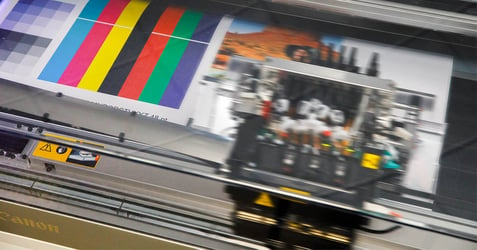
2. Canon varioPRINT iX1700: high-volume, quality-focused mail
Our pick for: print providers and in-plants running recurring mail programs where quality matters.
The iX1700 runs up to 170 images per minute, with coated and uncoated stock support up to 450 gsm, pairing inkjet economics with the print quality expected for premium mailers and postcards. Its PRISMAsync controller natively supports the variable data formats mail programs use, including PDF/VT and PPML, so personalized files go to press without workarounds. Rated for 300,000 to 2 million images per month with up to 15,300 sheets of paper capacity, it's sized for recurring volume.
3. Ricoh Pro C7500: mid-volume, high-impact personalization
Our pick for: campaigns that need to stand out in the mailbox.
A fifth color station turns personalization into something people notice. Neon, metallic gold and silver, white, and clear toners can make a name, an offer, or a QR code the first thing the eye lands on. Invisible red toner prints hidden codes or tracking marks that show only under UV light, which is useful for response tracking, security features, or interactive campaigns. Stock up to 470 gsm and oversized sheets cover thick postcards, self-mailers, and dimensional pieces that office devices can't run.
4. RISO ComColor GL Series (GL9730 / GL7430): high-speed addressing and simple color mail
Our pick for: addressing, inserts, and simple color mail pieces at high speed.
The GL9730 runs up to 165 ppm. Because RISO's oil-based ink prints without heat, sheets come out flat and feed cleanly into folding and inserting equipment, which keeps the mail line moving after the print step. Best on lighter stocks up to 210 gsm. For heavy postcards, see the Canon or Ricoh.
Real-world examples of variable data printing
- Retail promotions: coupons and product recommendations based on purchase history, like a grocery flyer with discounts on items a customer buys regularly.
- Event invitations: personal invitations with the recipient's name, a map from their location to the venue, and a unique RSVP code.
- Nonprofit fundraising: thank-you letters that reference last year's gift and what it accomplished.
- Healthcare communications: appointment reminders and patient statements printed in sealed envelopes or secured self-mailers, so personal details stay private.
- Manufacturer and dealer programs: co-branded mailers that carry each dealer's name, location, and local offer from a single campaign file.
What it takes to run variable data printing in-house
A press is one piece of a VDP program. The bigger risks sit upstream and downstream with messy data, files that weren't built for variable output, and a finishing line that can't keep up. When we help an in-plant bring personalized mail in-house, we look at the whole workflow:
- VDP software that fits your team's design tools and data sources.
- Data and file setup so templates, images, and records merge cleanly the first time.
- Finishing and mailing integration that connects the press to folders, inserters, and addressing.
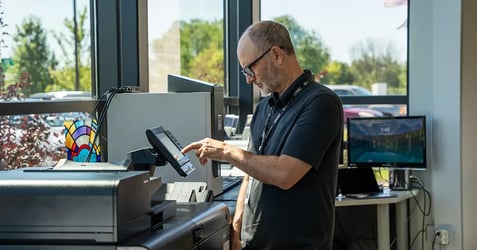
- Operator training so your team understands the workflow, not just the equipment.
EO Johnson is a family- and woman-owned Midwest company that has served businesses since 1957. Our production print team works with commercial printers, in-plant print departments, and in-house marketing teams to match the equipment and the process to the work.
Frequently asked questions on variable data printing
Bring personalized mail in-house
If you're evaluating production print solutions for personalized mail, our team can review the campaigns you run today, the data behind them, and the equipment that fits. Talk to our production print team or see the equipment run at our Customer Experience Center in Eau Claire, Wisconsin.