Updated March 2, 2026
For decades, offset dominated larger commercial print production environments. But market pressures like shorter runs, faster turnarounds, and personalized marketing are shifting the economics. High-speed production inkjet is no longer an alternative technology. For many commercial print shops, it’s becoming the primary engine for profitable short-run work.
Below, we break down what’s driving the shift, the financial realities behind it, and the key questions print managers should be asking.
What’s driving the shift from offset to inkjet?
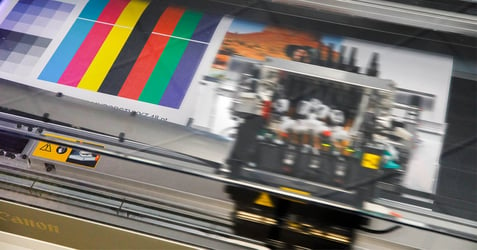
As print-on-demand becomes the industry standard, digital inkjet presses offer several practical benefits that address the needs of today’s print buyers. Here are some of the advantages driving this transition:
1. Run lengths are shrinking
Clients aren’t ordering 50,000-piece runs anymore. They order 5,000 or maybe even 500 multiple times per year.
Offset presses were built for volume. But as run lengths shrink, offset setup costs for plates, makeready time, labor, and waste consume a larger percentage of the job margin.
High-speed production inkjet eliminates plates entirely. That fundamentally changes short-run print profitability.
2. Print-on-demand is now expected
Today’s buyers want faster fulfillment and reduced inventory risk. That’s where print-on-demand efficiency becomes a competitive advantage.
Digital inkjet technology allows printers to:
- Print only what’s needed
- Reduce warehousing
- Shorten turnaround times
- Update content between runs
Offset excels at long-run consistency while inkjet excels at agility.
3. Personalization is no longer optional
Variable data printing (VDP) is now standard in direct mail, healthcare communications, education outreach, and retail marketing.
Offset can’t easily personalize at scale, and inkjet handles variable data printing natively without slowing production. For commercial printers serving data-driven clients, that capability alone can justify the investment.
The economic reality of inkjet vs offset printing
The real comparison isn’t about quality anymore. It’s about cost structure.
Understanding offset setup costs
With offset, profitability depends on spreading setup costs across a large volume. Every job requires:
- Plates
- Press setup time
- Paper waste during makeready
- Skilled labor for changeovers
For long runs, that works. For short runs, margins shrink quickly.
When run lengths drop below a certain threshold, offset becomes inefficient, especially when jobs are frequent and varied.
Why short-run print profitability favors inkjet
Digital inkjet technology removes plates and reduces setup time dramatically. That means:
- Faster job changeovers
- Lower labor involvement
- Minimal waste
- Consistent output from first sheet to last
As a result, short-run print profitability often tips in favor of high-speed production inkjet even if per-click costs appear higher at first glance.
The key is total job cost, not just cost per impression.
Where offset still makes sense
Offset printing continues to dominate in specific scenarios, particularly when extremely long runs are required, certain packaging applications need to be produced, or jobs demand highly specific color processes.
The transition in the industry isn’t about eliminating offset printing altogether, but rather about redistributing workloads more efficiently.
Many commercial printers are shifting short-run direct mail, transactional print, versioned marketing materials, and frequent reprints to inkjet platforms, while reserving offset presses for ultra-long run jobs.
The question becomes: Are you running short-run work on a platform designed for long-run production?
Operational advantages of inkjet presses beyond cost
For print managers and owners, equipment decisions aren’t only financial. They’re operational.
High-speed production inkjet systems:
- Run continuously with fewer manual interventions
- Reduce bottlenecks between jobs
- Integrate with automated workflows
- Have faster employee training times
For shops struggling to hire skilled press operators, automation matters.
Questions to ask when considering digital inkjet technology
If you’re evaluating inkjet vs offset printing for your operation, start here:
The bottom line on inkjet production
The debate around inkjet vs offset printing isn’t about which technology is “better.” It’s about which technology aligns with your client’s demands.
Offset remains powerful for long runs.
But for short-run print profitability, print-on-demand efficiency, and faster turnarounds, high-speed production inkjet technology increasingly delivers stronger margins and greater flexibility.
For commercial printers facing shrinking run lengths and rising cost pressure, the migration makes good economic sense.
The real question isn’t whether inkjet replaces offset but instead how much of your current offset work is already better suited for inkjet.
Ready to unlock new possibilities? Contact us today to discover our industry-leading line of inkjet presses and leverage our unmatched production print expertise to drive your business success.