Updated February 9, 2026
In 2026, digital transformation is less about adding technology and more about removing the friction that overwhelms employees, especially as AI-driven tools become part of everyday work.
For many organizations, that friction shows up in small but constant ways like employees searching for documents across multiple systems, double-checking whether a file is current or compliant, or manually moving information from one tool to another just to complete a single task.
As AI enters the workplace, these everyday inefficiencies don’t disappear - they multiply.
What is cognitive load and why does it matter?
Cognitive load is the amount of mental effort employees expend just to get work done. In practice, it’s the extra thinking required to locate information, move between systems, and make judgment calls that technology should be handling for them.
When cognitive load is high, productivity drops, errors increase, and frustration builds. Employees spend more time managing systems than focusing on meaningful work.
In many organizations, excessive cognitive load in the workplace shows up as:
- Tracking where information lives across multiple systems
- Switching between tools to complete a single task
- Repeating manual steps because systems aren’t connected
- Questioning whether documents are current, compliant, or secure
- Spending time “figuring things out” instead of moving work forward
If this sounds familiar, it’s because most workplaces already operate under high cognitive load.
As AI becomes more embedded in everyday work, this problem becomes harder to ignore. AI depends on clean, trusted information and consistent usage. When those foundations aren’t in place, AI doesn’t simplify work and instead adds new tools and decisions on top of existing friction.
That’s why reducing cognitive load is a critical requirement in the AI era. Employees don’t need more features. They need fewer decisions, clearer workflows, and systems they can trust and actually use.
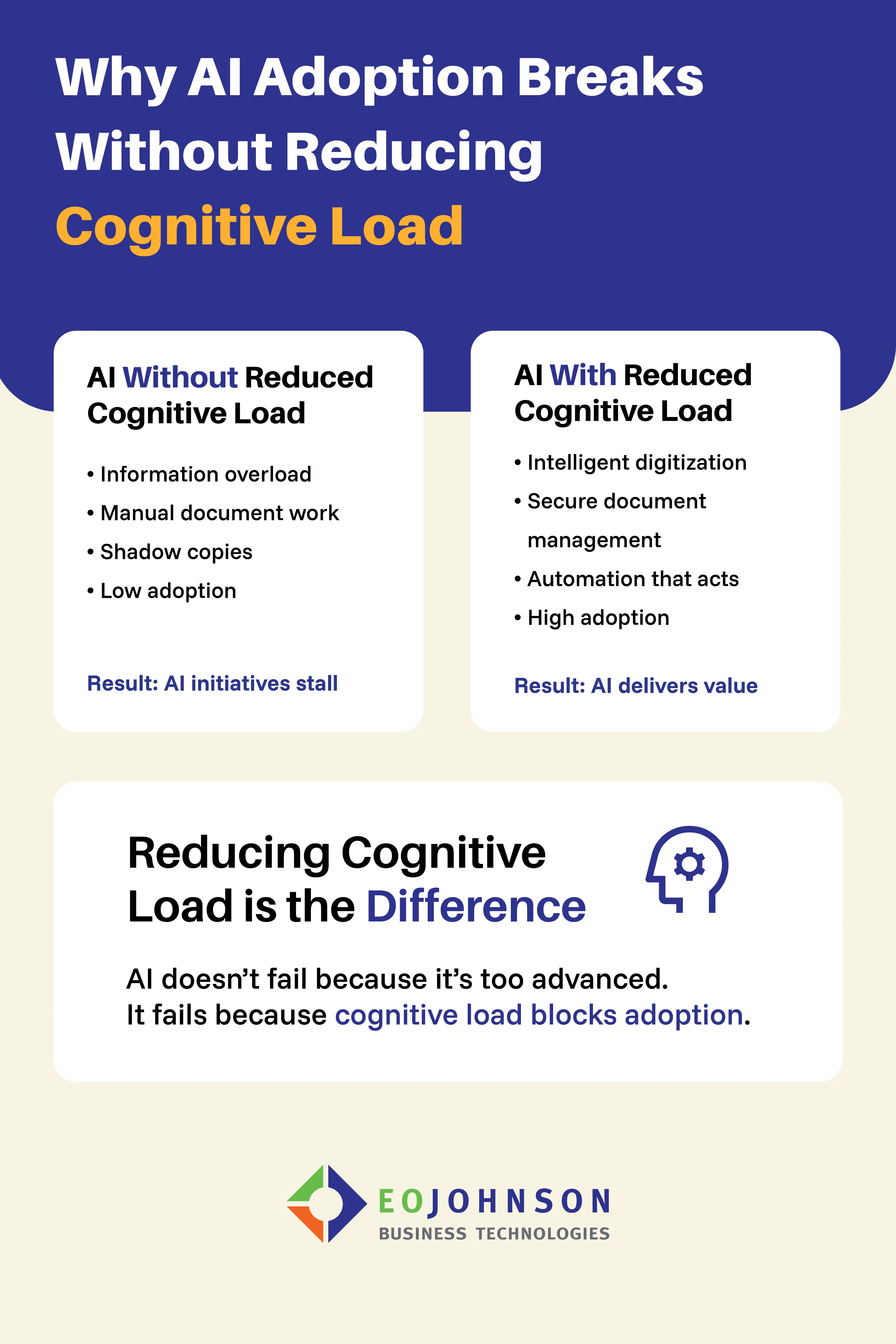
A modern document management system (DMS) supports this shift by simplifying access to information, automating routine steps, and guiding users through their work. When a DMS reduces cognitive load, it stops feeling like another tool and becomes essential infrastructure for driving adoption and unlocking real value from AI-enabled initiatives.
How modern DMS reduces cognitive load
Digital friction, or when technology adds steps instead of removing them, raises mental effort and undermines adoption. Long training, complex folders, and rigid workflows all increase cognitive load.
The best document management systems remove this friction by fitting naturally into existing workflows. The goal is not to force behavior change, but to make daily work simpler for teams already stretched thin.
When employees feel that a system saves them time and reduces hassle, adoption follows naturally.
Making information instantly usable
Intelligent digitization goes beyond document scanning and turns years of paper files into structured, searchable data. This eliminates the mental burden of hunting for information, letting employees focus on work instead of document retrieval.
For organizations with limited resources, outsourcing bulk document scanning can quickly clear backlogs and preserve institutional knowledge. Once digitized, legacy documents become immediately accessible and actionable inside the DMS.
-
Contracts are instantly searchable
-
Records are available across locations
-
Data can fuel internal AI tools
This makes a DMS valuable from day one and reduces the time and thought spent searching for information.
This step is foundational in the AI era.AI tools are only as effective as the information they can access. When documents remain trapped in paper files or poorly indexed repositories, AI increases frustration instead of insight and forces employees to work around both the system and the technology meant to help them.
Building trust through secure design
A secure document management system reduces cognitive load by removing uncertainty. If employees don’t trust the system, they create workarounds which add complexity
Modern platforms use zero-trust principles, role-based access, and audit trails to protect information and simplify compliance. Employees no longer need to guess what’s safe to share or store because the system guides them through it, reducing anxiety and effort.
Automating routine work to free up focus
In the AI era, employees don’t want systems that ask for more input. They want systems that take work off their plate. Modern DMS solutions now go beyond customization and act on behalf of users. By automating repetitive, low-value tasks, agentic workflows further reduce cognitive load:
- Routing invoices for approval automatically
- Flagging expiring contracts
- Notifying teams about missing documentation
Automation eliminates administrative overhead, allowing employees to focus on priorities. When users see the system proactively helping, their trust and adoption grow.
Using analytics to continuously reduce cognitive load
Challenges with adoption aren’t about employee resistance and instead are signals for improvement. Modern DMS platforms use adoption analytics to pinpoint where cognitive load is highest and where friction occurs:
- Which departments avoid certain features
- Where users stall or drop off
- What processes cause repeated errors
This data enables organizations to deliver targeted support and make the system easier to use without overwhelming teams with unnecessary training.
Reducing cognitive load is the true advantage of modern DMS and AI
In the AI era, adoption is the bottleneck. AI, automation, and advanced analytics only deliver value when employees actually use the systems that power them. For operations leaders balancing compliance, efficiency, and limited resources, reducing cognitive load is the fastest path to successful document management adoption and creating a calmer, more productive way of working.
The most powerful document systems aren’t those with the most features. They’re the ones that reduce cognitive load so consistently that adoption becomes effortless.
Ready to streamline your workflow and empower your teams? Discover how our document management systems can help you reduce cognitive load, increase adoption, and transform the way you work. Contact us today or request a free demo to see the benefits in action.