Updated February 23, 2026
The workforce conversation has shifted. In 2021, businesses were asking, “Where did all the workers go?” In 2026, the smarter question is: “How do we empower the people we have?”
For operations leaders across industries, the pressure hasn’t eased. Labor costs are rising. Hybrid work is here to stay. Compliance requirements are tighter than ever. And expectations for speed and service continue to grow.
The answer isn’t pushing your team to work harder. It’s eliminating the cognitive load and digital friction that slows them down.
That’s where document process automation comes in.
Manual processes are the real workforce drain
For many mid-sized organizations, especially in highly regulated industries, the real bottleneck isn’t talent. It’s paper.
When a process requires someone to:
- Walk to a filing cabinet
- Scan and email documents manually
- Re-enter data into multiple systems
- Wait for physical approvals
…it’s not just inefficient. It’s incompatible with modern business.
Operations managers often face challenges around physical space, information accessibility, security risks, and limited internal resources for large projects. Meanwhile, they are also trying to streamline operations, improve hybrid workforce support, meet compliance standards, and do more with fewer labor resources
Paper-based processes directly conflict with all these priorities because they:
- Slow down decision-making
- Increase the risk of lost or exposed information
- Create burnout from repetitive administrative work
- Prevent remote and hybrid work flexibility
- Make compliance audits more stressful
In short, they quietly drain your workforce capacity.
The scanning to automation journey that scales your team
Document scanning is often the entry point of the efficiency journey but automation is the destination.
Step 1: Digitize your information
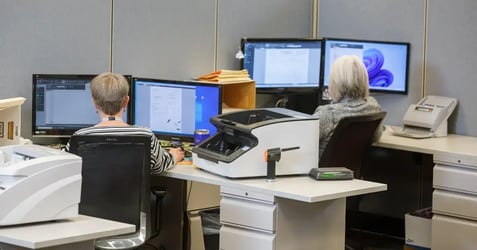
Professional bulk scanning services convert paper files into secure, searchable digital records. This immediately:
- Frees up physical office space
- Reduces risk of disaster-related loss
- Improves accessibility across locations
- Preserves historical and compliance-critical records
For industries like healthcare and government, where record retention and privacy are essential, digitization strengthens both security and risk mitigation
But simply scanning documents isn’t enough.
Step 2: Create a single source of truth
A modern document management system (DMS) centralizes information into one secure digital environment.
Instead of documents living in filing cabinets, inboxes, shared drives, and desktops, your organization gains:
- Instant retrieval through keyword search
- Role-based access controls
- Version control and audit trails
- Secure cloud or hybrid hosting
- Backup and disaster recovery
For hybrid teams, this becomes the foundation of hybrid work efficiency. Employees can securely access the information they need whether they’re in the office, at home, or in the field.
No more “I’ll send that when I’m back at my desk.”
Step 3: Activate digital workflow solutions
Here’s where true document process automation transforms operations. Instead of documents being stored, they move.
Automated workflows can:
- Route invoices for approval
- Trigger notifications for HR onboarding
- Flag compliance documentation for review
- Sync data with ERP or accounting systems
- Track status in real time
For accounting, HR, and legal teams, this eliminates repetitive data entry and manual routing.
The result? Faster cycle times, fewer errors, increased visibility, and less administrative “grunt work.”
This directly supports what many organizations now call “quiet thriving.” Employees stay engaged and productive when they’re not buried in filing, scanning, and chasing paperwork. Automation and process improvement protect your culture by reducing burnout.
Business process mapping delivers results through a consultative approach
Before investing in new technology, smart organizations first identify where process inefficiencies exist.
Document process automation works best when it’s built on a clear understanding of how information moves through your organization. That’s why business process mapping is the foundation of a successful automation strategy. It reveals where approvals stall, where manual tasks consume time, and where hidden operational costs impact productivity.
See process mapping in action
This short overview explains how process mapping uncovers bottlenecks, improves employee engagement, and creates a clear roadmap for automation.
Rather than simply installing software, a consultative partner acts as an extension of your leadership team to:
- Map existing processes
- Identify bottlenecks and redundancies
- Quantify time spent on manual tasks
- Design optimized digital workflows
- Implement with training and ongoing support
This structured approach ensures solutions are customized to your industry, compliance requirements, and budget instead of being one-size-fits-all. For many mid-sized organizations, internal teams don’t have the bandwidth to lead digital transformation alone. A high-touch partner helps ensure projects are completed efficiently, within budget, and with strong user adoption because automation only delivers results when your team actually uses it.
Security and compliance are higher priorities than ever
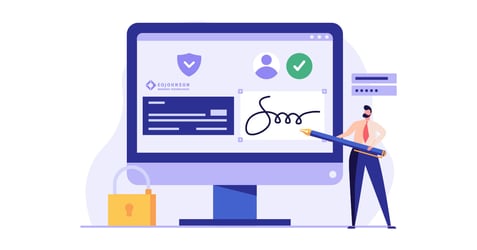
No matter your industry, data privacy expectations have only intensified. Whether it’s HIPAA in healthcare, FERPA in education, or broader data protection regulations, digital document management systems provide:
- Encrypted storage
- Controlled user permissions
- Detailed audit trails
- Automated retention policies
- Secure document sharing
Compared to paper files that can be misplaced, copied, or damaged, digital document management significantly strengthens compliance posture.
For CFOs, controllers, and operations leaders, this reduces both legal exposure and financial risk.
Working smarter is the only sustainable strategy
In today’s environment, scaling by hiring alone is neither affordable nor sustainable.
The organizations that remain competitive are those that:
- Centralize their information
- Automate repetitive processes
- Enable hybrid workforce flexibility
- Protect sensitive data
- Empower employees to focus on higher-value work
Document process automation doesn’t replace people. It elevates them.
When you remove manual document handling, your existing team gains capacity without adding headcount. Approvals move faster. Information is accessible instantly. Compliance is easier to manage. Employees spend more time solving problems and less time searching for paperwork.
That’s how you scale intelligently.
The bottom line on document process automation
By transforming static paper into dynamic, actionable data, you create a true single source of truth that supports efficiency, security, compliance, and long-term workforce sustainability.
The hiring crisis may have sparked this conversation years ago. But today, the focus is on smarter growth. And document process automation is how you achieve it.
Ready to unlock the full potential of your workforce? Discover how our document scanning, document management, and process improvement solutions can streamline your operations, safeguard your data, and drive smarter growth. Contact us today to schedule a demo or learn more about transforming your business for the future.